Sister Maria Ursula
Bärbel LAMMERDING ND 6256 PDF Download
Maria Regina Province, Coesfeld, Germany
Date and Place of Birth: September 01, 1942 Kirschesch/Eifel
Date and Place of Profession: March 24, 1966 Vechta
Date and Place of Death: December 16, 2025 Coesfeld, Kloster Annenthal
Date and Place of Funeral: December 23, 2025 Coesfeld, Convent Cemetery
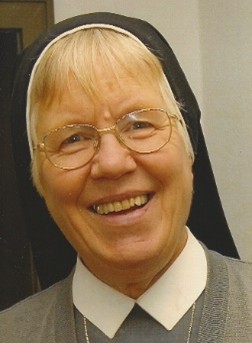 “I will sing and play for the Lord.“ Sr. M. Ursula has lived out this motto in her religious life.
In the middle of World War II, Bärbel was born as the third child of Heinrich Lammerding and his wife Katharina. On January 18, 1943, her father was killed as a soldier in Stalingrad. Her mother had to raise the three children alone. After the war, the family moved to Vechta. The eldest son died of asthma at the age of 16.
Bärbel attended Liebfrauenschule, a middle school for girls in Lohne, graduating in 10th grade. She then completed her education at the Landfrauenschule (agricultural school for women) in Vechta-Marienhain. This was followed by a two-year training course as a kindergarten teacher in Osnabrück. In May 1963, she entered the Congregation of the Sisters of Notre Dame in Vechta and was given the name Sr. Maria Ursula at her investment. During her novitiate, she suffered greatly from not being allowed to play an instrument. She had kept a small flute and sometimes played it secretly. After her profession in 1966, Sr. Maria Ursula was assigned to the congregation’s boarding school in Vechta. In 1968, she was the only woman to begin studying church music in Aachen, graduating in 1970 as an organist and choir directress. She then studied theology at the Catechetical Institute in Aachen and obtained a teaching license for religion at elementary and secondary schools. This was followed by a teaching position in Vechta at the Technical College for Social Pedagogy.
After a period of preparation in Rome, she made her final vows there on March 19, 1973. Marienhain in Vechta then became the center of her life. As an organist, she played an important role in church services. Her organ music made special celebrations unforgettable, whether they were jubilees, Easter Vigil, or Christmas. For many years, the Holy Spirit Church was overflowing on these days. During Advent, she enjoyed waking the sisters with her flute on Sunday mornings.
For 22 years until 1995, Sr. M Ursula accompanied school classes on weekends at the youth center in Vechta. With her enthusiasm, she conveyed to the young people that a life based on faith can be fulfilling. During this time, she also accompanied numerous large youth pilgrimages to Lourdes, Rome, and Krakow. Sr. M. Ursula always created a good atmosphere with her guitar. She brought songs back to Marienhain from trips to Taizé. From then on, “Surrexit dominus vere” became part of all Easter celebrations. With her accordion, she was invited to provide musical accompaniment for numerous senior citizens’ and women’s gatherings, whether for a St. Nicholas celebration or a carnival party.
The sudden death of her brother Peter in 1997 was a heavy loss for Sr. M. Ursula, and she has missed him greatly ever since. She kept in close contact with her niece Esther in England.
After finishing her youth work, she began a new chapter in her life working as a music therapist at the newly founded aphasia center in Langförden. Through music she was often able to encourage patients who had lost their speech after a stroke, and they would be able to sing again; it was a small miracle every time. During this time, she also volunteered to care for coma patients and self-help groups. At the beginning of 2011, she retired from the aphasia center after 16 years.
Sr. M. Ursula continued to play the organ in Marienhain and also served as organist in other churches in the parish. Through her contacts from youth work, she also provided musical accompaniment for many church weddings in the convent church.
For health reasons, Sr. M. Ursula moved to the senior center in Coesfeld on January 6, 2024. She quickly settled into the sisters’ community and surprised and delighted us with her talent for improvisation on the organ. Her organ playing was often an expression of her prayer, when the melody of the hymns “Christ, Divine Lord” or “Jesu, joy of man’s desiring” resounded.
In the third week of Advent, she was allowed to see the final arrival of her Lord.